How it works
The AI prepares. A person decides.
Three steps that every card goes through, and the one rule the system is built on: the agent never sends, deletes or pays.
How the handoff works
The AI prepares. A person decides. Every leg has a name on it.
Every card shows who runs this leg – a person or an agent –, who takes the baton next and who signs. Nothing leaves the company unsigned, and the cost of the AI leg is on the card in euros.
- 1 · The AI
The AI runs its leg
It reads the card and the company documents, writes the draft, checks it – no foreign links, no leaked data – and puts it on the baton with its cost in euros.
- 2 · You
You take the baton
The draft waits in the exchange zone: the approvals queue. You see the exact content, the recipients, the time and what the AI cost. One by one or in bulk, or sent back with a reason.
- 3 · Signed
You sign, it goes
Sending, publishing and paying happen only with your signature, bound to the exact content – change a word and it asks again. The card keeps who, when, what and the cost.
- Leg 1 · the AIAgent "Editor"draft ready · 18 min saved
- Leg 2 · a personAnna, marketingtakes the baton · signs
The agent never sends, deletes or pays. It has no tool for it – that is how the system is built, not a setting.
One platform for everyone
The office, the manager, the maintenance person, the cleaner, the bartender – one board
Nobody needs a second app. The office works on the desktop, the floor on the phone; a card moves between them with its photo, its owner and its cost.
- Office
- Manager
- Maintenance
- Cleaner
- Bartender
- Driver
- Front desk
- The cleanerLeaking tap, room 12photo · 07:42
Reports the fault with a photo, from the phone (a QR code on the wall is coming soon).
- MaintenanceFix the tap, room 12today · owner: Tom
Gets the card on the phone, fixes it, ticks it off with a photo.
- The managerPlumber invoice · €85waiting for approval
Sees the cost, signs or sends it back – from the desktop or the phone.
The same card, three people, no re-typing. The office sees it on the board, the floor sees only its own day.
Chat
Talk where the work is – and nothing said gets lost
Channels, threads and voice notes, with the agent as a member of the channel. What is decided in chat becomes a card, and what is worth keeping goes into the company brain.
- Channels, threads, voicePer team, per project, per site. The agent answers when asked and speaks up when a card slips.
- Files and photos in chat coming soonA photo from the floor, a PDF from a supplier – sent in the thread and kept with the card.
- A task starts from a message coming soon"Make this a task": the message becomes a card with an owner and a due date, the thread stays linked.
- Save this to the brain? coming soonWhen a thread settles something – a rule, a price, a contact – the agent offers to save it to the company brain. One tap, and everyone and the AI know it.
- Requests and faults from the phone or a QR code coming soonRequest cleaning, report a broken light: a message or a QR code on the wall creates the card for the right person.
Tap leaking in room 12, water on the floor.photo
Make this a task for maintenance, due today?Create task · coming soon
On it after lunch.
Save "tap in room 12 replaced, 28 Oct" to the company brain?Save · coming soon
Items marked "coming soon" are being built now; the page says so until they ship. The agent never sends, deletes or pays – in chat too.
The company brain
One shared memory of the company – people and the AI read the same thing
Rules, templates, prices, client files, the way you write: written once, in one place. Everyone finds it, and every agent works from it instead of guessing.
What goes in
- Documents and wikiRules, house style, templates, checklists – the pages you would otherwise keep in six places.
- Client filesWho the client is, what was agreed, what the last mail said.
- Decisions from cardsAn approved draft or a returned one teaches the agent what you want.
- Chat memory coming soonWhat a thread settled, saved with one tap.
Who reads it
- PeopleThe new colleague finds the rule on day one; nobody asks the same question twice.
- The AIEvery draft starts from your rules and your tone – not from a generic model.
The brain is yours: export it any time, delete it when you leave. No model is trained on it.
See it in 60 seconds
What it looks like when the AI hands over the baton
Real screens from Stafeta (sample data). Not a demo video: this is what you see in the first ten minutes.
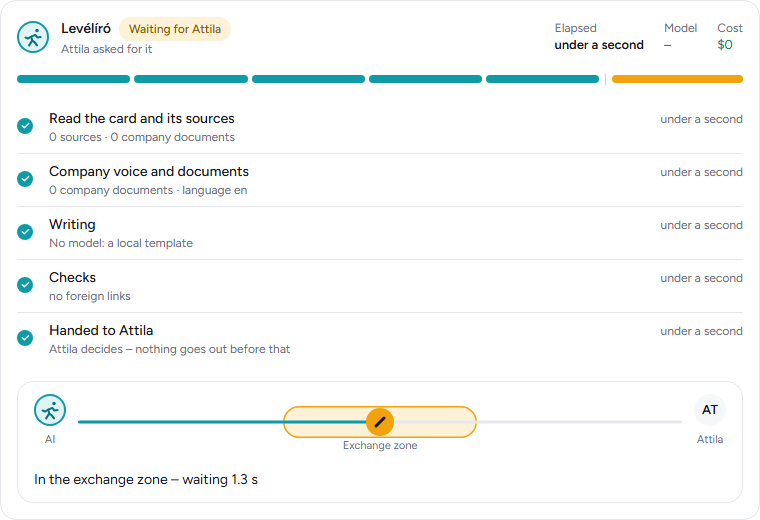
The AI run, step by step
It reads the card and the company documents, writes the draft, checks it (no foreign links, no leaking data) and puts it on the baton: it waits in the exchange zone until a person decides. Nothing goes out before.
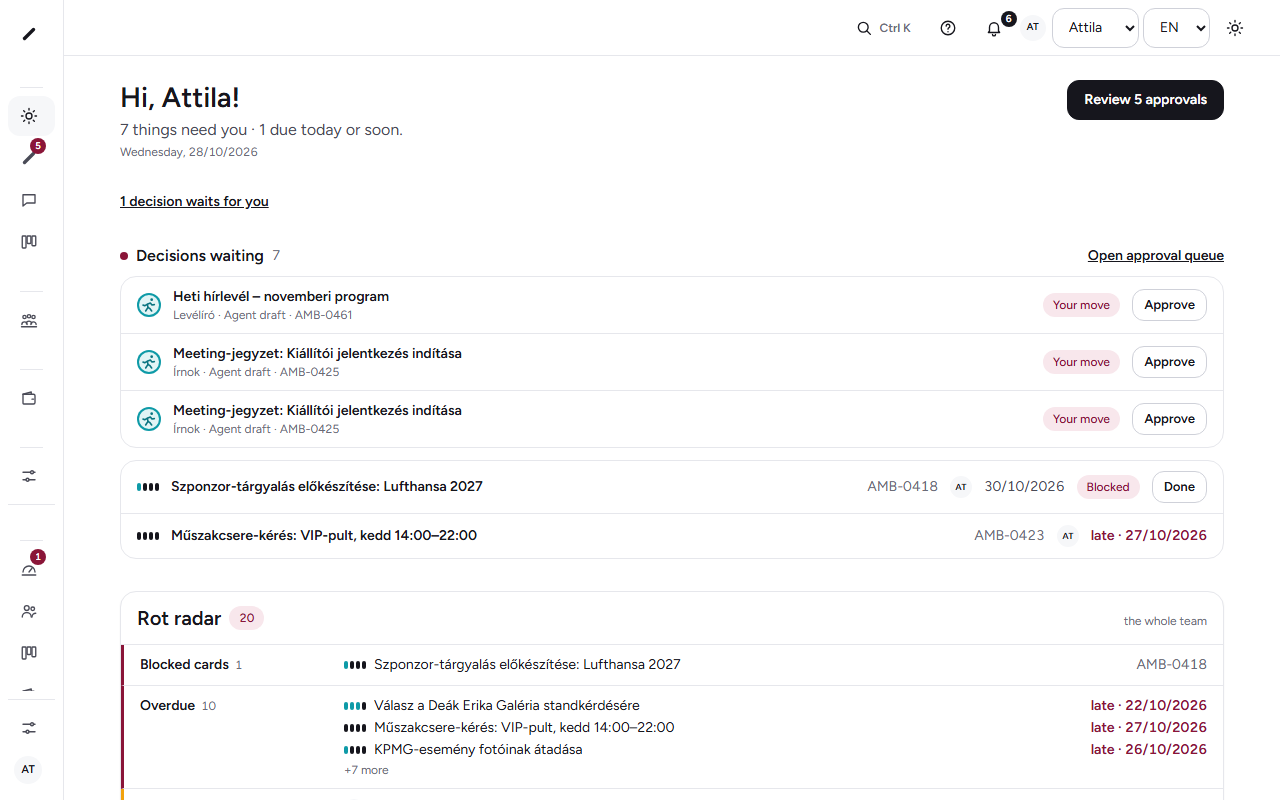
My day: what waits for you
Decisions, slipping deadlines, the rot radar – one screen in the morning, not six apps.
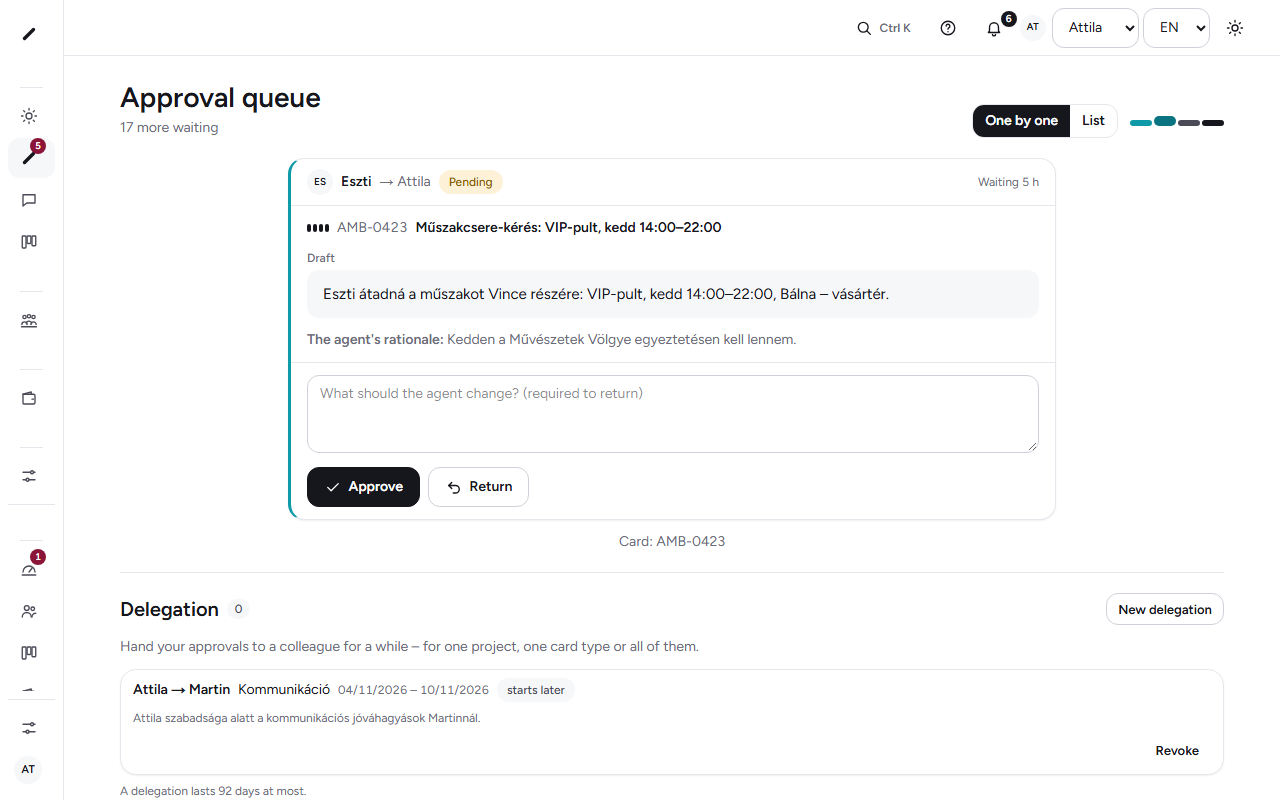
Approvals: the exchange zone
The agent's draft, a colleague's request, leave, an expense – one queue. One by one or in bulk, returned with a reason.
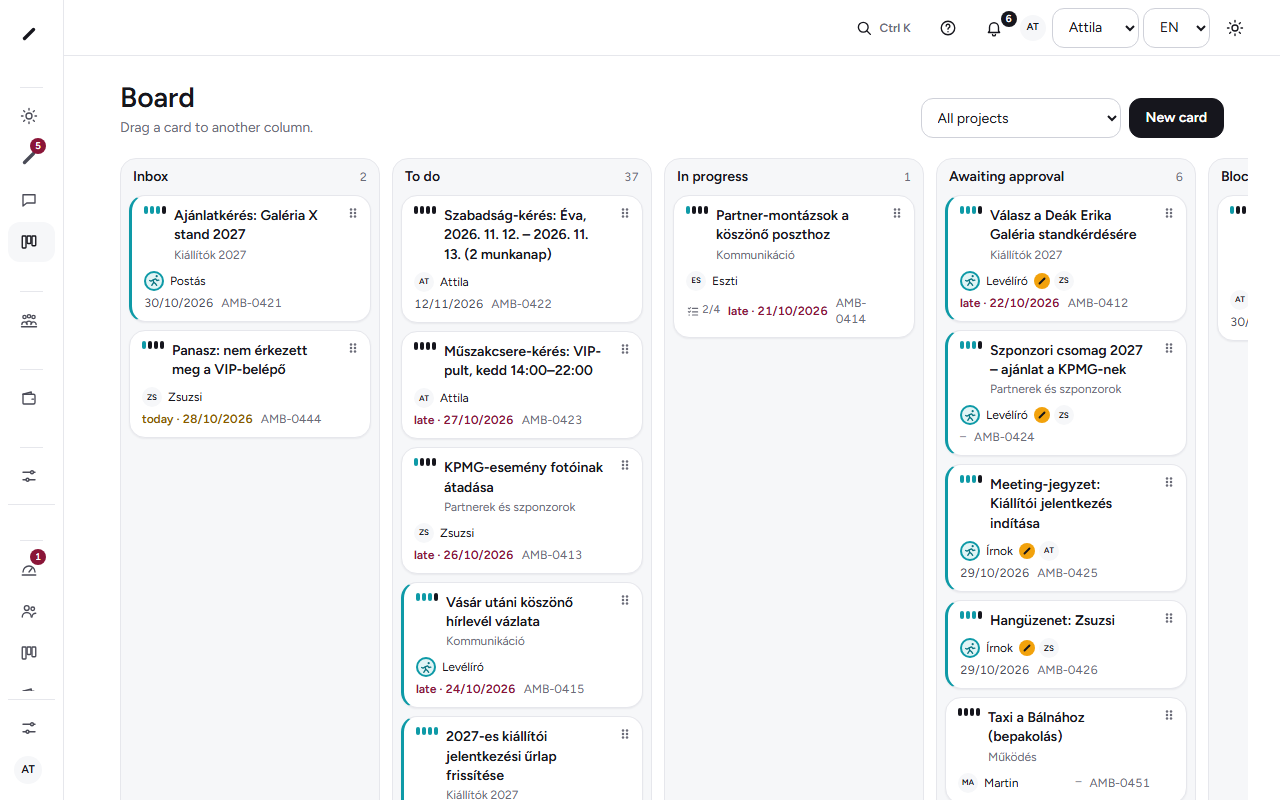
The board: who carries what
Every card shows its owner – person or agent –, the lane, the due date, and the baton when the AI is handing over.
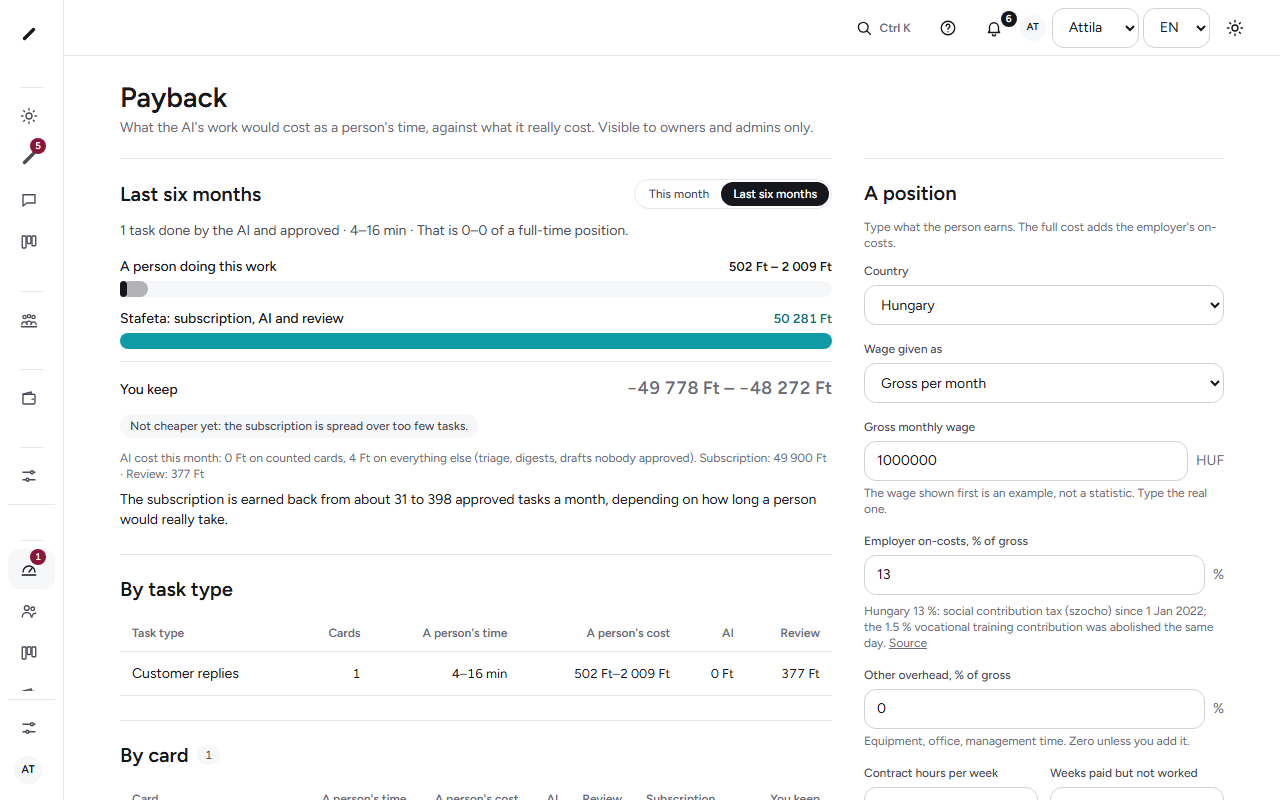
Payback, not a promise
What the AI's approved work would have cost in a person's time, against what it really cost – with your wage figures, in your browser.
Sample data from a six-person events company. The numbers will be yours.
Security – the first thing we built
Your company's data stays yours. Inside, too, people see only what they need.
We do not promise with adjectives but with how the system is built. Everything here works today; what is still a plan is marked as such.
Every company sealed off – at the database level
Every table knows, row by row, which company a record belongs to, and only that company's members can reach it (row-level security). The database itself filters, not the app; an automatic check allows no table without it.
Two-step sign-in for everyone – not an option
A password (or Google/Apple) and an authenticator-app code on every sign-in, no SMS. Sensitive steps – roles, export, billing, deletion – ask for a fresh code.
Data and files in the EU
The database, files and backups in Frankfurt, the server that runs the AI work in Vienna, the website served from Frankfurt.
The AI sees less than your employees
It only drafts: it has no send, delete or pay tool. It works with the company's own rights and never sees another company or a key. A field you mark "hidden from agents" never reaches it.
A message between two people stays between them
Private messages sit outside every workspace: no admin reads them, no AI reads them, and not even our own server key can reach them through the interface – only the two participants.
Every action is logged
Sign-ins, card changes, approvals (bound to the exact content), decisions together with the dissent, admin actions: who, when, what. The owner can read it back.
No model is trained on your data
AI drafts are produced by Anthropic (Claude) under its commercial terms: what we hand over is not used to train models. Anthropic processes in the USA under the EU–US Data Privacy Framework and standard contractual clauses – details in the privacy notice.
Coming next – a plan, not a promise
- Need-to-know inside the company: visibility per department and per site, sensitivity labels, "who viewed what".
- A tamper-evident (chained) audit log.
- An external penetration test, then an ISO 27001 / SOC 2 roadmap.
- AI processing in an EU cloud region – planned for institutional customers; the decision is still open.
Trust & security – the full page → Including what is not there yet.
Two minutes to sign up, two-step sign-in, the first AI draft within ten minutes. Then you decide.